
Dear Friends,
CLICK HERE FOR THE FULL PROGRAM, with Charles Goldman and Ed Fallon:
(01:23) Are we seeing rebellions within both major political parties? – LISTEN
(19:00) Trump and the Christo-fascist movement – LISTEN
(40.39) Mail-in ballots are still up in the air for fall election – LISTEN
(51:51) State fairs — oldest, youngest, biggest, best, with Kathy Byrnes – LISTEN
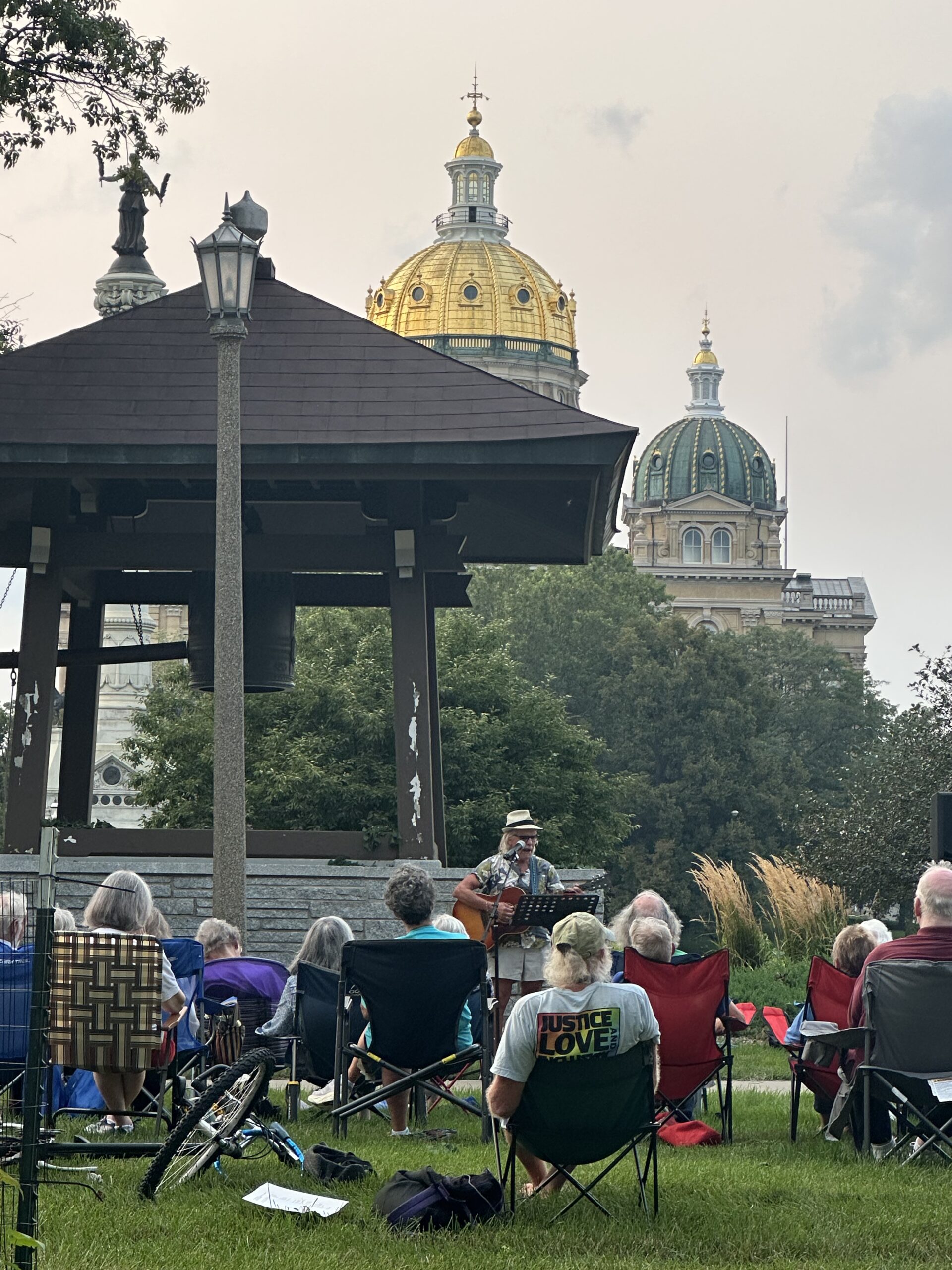
Seventy people gathered in Des Moines for the annual Hiroshima-Nagasaki Commemoration. The Japanese Bell of Peace is behind the singer, with the Iowa State Capitol behind that.
There’s lots of good content in this week’s radio show/podcast. I hope you’ll listen and share your feedback.
I want to focus on a topic not covered in this week’s program: the 1945 atomic bombing of Hiroshima and Nagasaki.
Every year since the late 1970s, a coalition of Iowa peace groups has commemorated the bombings with song, speeches, and ringing the Japanese Bell of Peace and Friendship at the Iowa State Capitol.
That bronze bell weighs 2,000 pounds and was gifted to Iowa in 1962 by our sister state, Yamanashi Prefecture, in response to Iowans providing humanitarian aid following two devastating typhoons.
Every year, the commemoration reminds us of the horror of nuclear war. That horror has haunted me for over sixty years. In 2018, I wrote about it in my memoir, Marcher, Walker, Pilgrim:
War terrified me from an early age. I first learned about Vietnam when I was six. I’d lie in bed paralyzed by fear at the roar of jet engines being tested at General Electric two miles away. I thought the Vietnamese were coming to kill us.
Mom tried to reassure me that there was nothing to worry about. The noise came from the factory where she and my dad used to work, where they’d met in fact. It was a good place, nothing to be scared of.
She made no mention of the napalm being dropped that night on sleeping Vietnamese children by planes powered by those very engines. Like most Americans in the early 1960s, Mom dutifully swallowed the anti-communist propaganda, ignoring the occasional images of truth and horror that slipped through the pro-war ideologues’ shield of deceit.
For many years, I had nuclear nightmares. In one recurring dream, I would stand in a city devastated by a nuclear attack, handing out water and food to scarred and burned victims.
The nightmares ended when I became a peace activist, at first in Ireland in 1984, then with deeper commitment in Iowa in 1985. By 1986, I was full-time engaged with peace work — coordinating the Iowa stretch of the Great Peace March and later founding Des Moines Campaign for Nuclear Disarmament.
In 1989, I invited Mayumi Fukuda with the Never Again Campaign to visit Des Moines to share her perspective on nuclear war as a Japanese woman. She lived with my family for six weeks, presenting dozens of times to schools, churches, and the media.
Mayumi was hardly the first Japanese person to visit the US to speak out against nuclear weapons. Garrett Graff writes about the Hiroshima Maidens in his August 10, 2026, “Doomsday Scenario” blog:
The Hiroshima Maidens were a group of schoolchildren who had been injured and disfigured by the blast, who came to the US ten years after the attack for plastic surgery and treatment. As [Alex] Wellerstein writes, “The primary intent was to ease their individual suffering, but the trip was understood by all involved to be more than that: the wounds being healed were not just physical, but political.”
Nuclear weapons are indeed a political problem. They demand a political solution. Sadly, and frighteningly, no US president has been willing to tackle the challenge.
In Prague in April, 2009, President Obama said, “I state clearly and with conviction America’s commitment to seek the peace and security of a world without nuclear weapons.” He then went on to sign multiple bills that increased spending for nuclear weapons.
President Trump at one time offered hope that he understood the nuclear threat and would address it. In 2016, he said, “I would like everybody to end it, just get rid of it.”
Of course, Trump has done nothing to “get rid of it.” Like Obama, he’s gone the opposite direction.
According to the Arms Control Association, “nuclear forces would cost a total of $87 billion in fiscal 2026 under the White House plan. That would represent a 26-percent increase over the Biden administration’s last budget request, and the second year in a row in which total nuclear costs have increased by more than 20 percent.”
It often feels hopeless. But the peace activism of the 1980s brought real change.
An end to nuclear testing.
A meaningful reduction in US and Soviet nuclear arsenals.
The Great Peace March gave birth to the American-Soviet Peace Walks in 1987 and 1988. I can’t prove it, of course, but those of us involved with that work believe our efforts helped bring about the fall of the Berlin Wall and the dissolution of the Soviet Union.
It’s disappointing that we seem to have regressed. And it’s disappointing that today’s peace movement is but a shadow of the powerful force that shook the halls of power across the world in the 1980s.
But as the speaker at last week’s Des Moines commemoration, Ted Lytton Hatten, said, we need to build the road to peace one relationship at a time. Those relationships might be friends, neighbors, family members, elected officials, or a candidate for Congress. It’s all important. Every stone thrown has its ripples.
We act not only because we need change but because it’s essential for our own well being. As Joan Baez said, “action is the antidote to despair.”
I certainly found that out in 1984. When I took action, the nightmares ended. The sense of hopeless disappeared.
Because even if a cause seems hopeless, it’s not. We don’t know how this plays out.
I’ll leave you with one more quote, widely attributed to Mahatma Gandhi: “Whatever you do in life will be insignificant but it is very important that you do it because you can’t know.”
Thanks for reading, listening, and taking action. And if you’re a central Iowa resident, remember to support the local businesses and nonprofits that help underwrite this platform.
Ed Fallon
*******
In addition to our PODCAST, listen to the Fallon Forum on these affiliates:
– KHOI 89.1 FM (Ames, Iowa)
– KICI.LP 105.3 FM (Iowa City, Iowa)
– WHIV 102.3 FM (New Orleans, Louisiana)
– KPIP-LP, 94.7 FM (Fayette, Missouri)
– KCEI 90.1 FM (Taos, New Mexico)
– WGOT-LP 100.1 FM (Gainesville, Florida)
– KRFP 90.3 FM (Moscow, Idaho)
– WGRN 94.1 FM (Columbus, Ohio)
— WJLQ 99.7 FM (Muskegon, Michigan)
– WRWK 93.9 FM (Midlothian, Virginia)
– WDRT 91.9 FM (Viroqua, Wisconsin)